Posted on Leave a comment

A Call to Abstraction – prelude

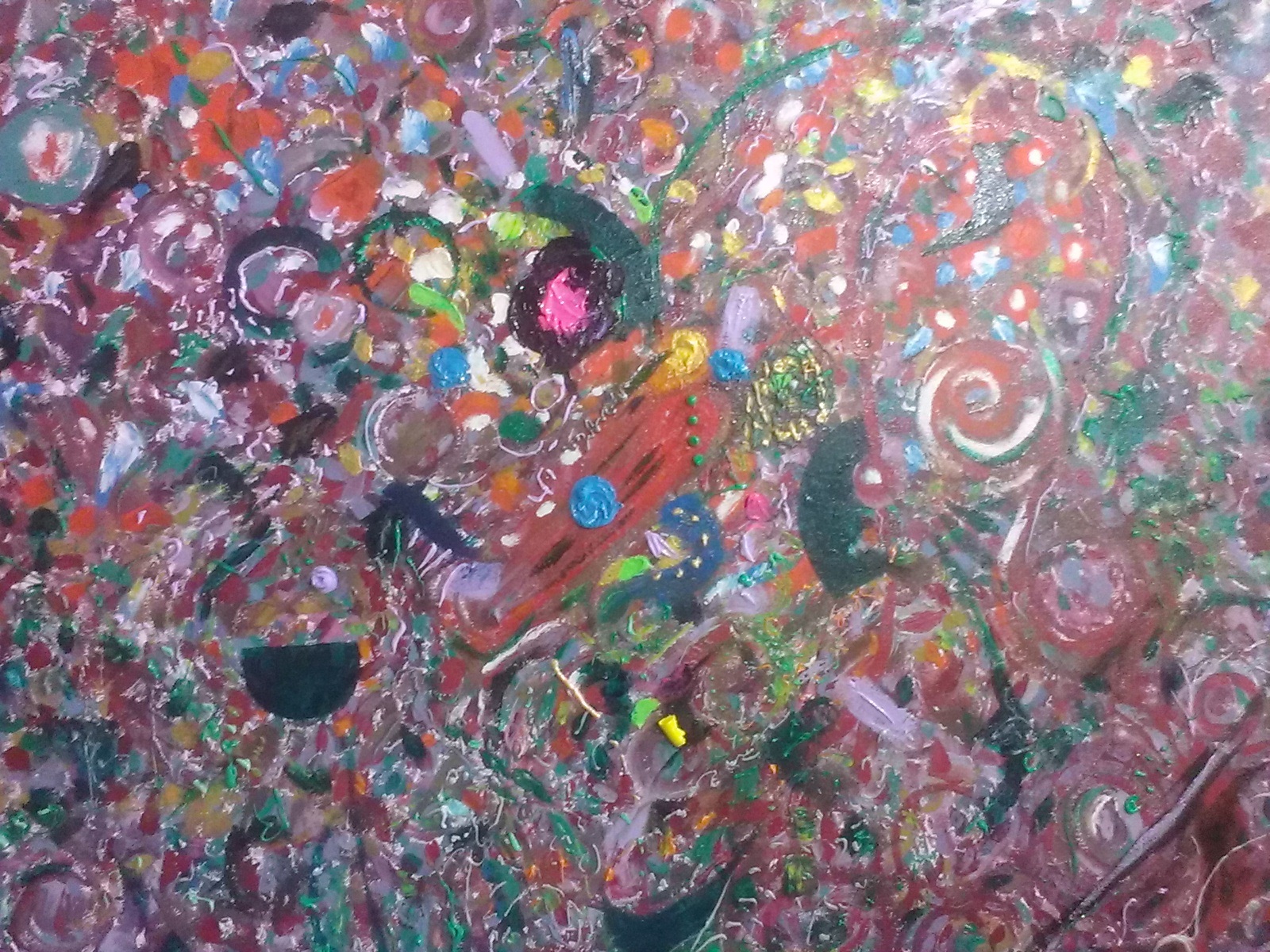
Leave preconceived ideas at home and explore color and form for what it does to the mind and body! Having recently conducted some workshops and a demo on automatism, layering, and abstraction, I am invigorated in the call towards are greater public understanding and celebration of the mental rocket fuel that is the Art of pure color and form.

Color and form speak to us in a way that language cannot, that  any image or idea that relates directly to an object cannot. Even when one paints a landscape, or a cow, one abstracts the essence or image of the cow in the form of a painted picture. Take the image away, and you do not lose the power that color and form have over our minds, our imagination, our sense of harmony.

We do not ask all of our music to narrate a highly literal theme, we celebrate the flow and rhythm of the notes and harmonies and sound combinations for their own sake, for how they make us feel or see. Listening to an opera in a foreign language does not diminish the beauty and power of the composition beyond the narrative. If anything, it brings a focus to the magic of the music, its subtle and bold powers, without the distraction of analyzing words or forming a literal theme. As a species, we are better off to incorporate this idea more ravenously into are larger social consciousness, particular when it comes to painting.

One important social implication of abstract painting, and the automatist, build as you go approach to composition, can be illustrated with the public mural. If one paints a mural from a narrative and personalized perspective one inherently stands to alienate at least some of the public who may not identify with or approve of the narrative. Sometimes, this is important, because some public Art is meant to incite an outcry towards perceived injustice, or questions our destructive environmental and consumption choices, which is meant to upset the current systems of the social order. But not only is it important that we have a greater rise in Art designed to unite and harmonize the positive potentials of our social consciousness, but to voice these in a universal language.

One language that almost all people are fluent in is color and form, which is to say, that whether or not you get or agree with a narrative or subject based public mural, one can be overtly and subconsciously moved by the color relationships and compositions integrity of the pieces as a whole. Take away the elements of narrative or representation that can hinder the full immersion in this other universal language, and you have a public spectacle with the potential to move and reach all viewers on a deeper level.

There is another, very important public implication in the move towards abstraction, and that is the collective, evolving mural. If a person paints a mural of a particular subject matter, in a particular representational technique, it serves as a period, a stop sign, to any other interaction with that surface. If I came behind a portrait painter and added a number of circles, however compositionally sound, it would be abhorred by and large as vandalism. But if the painting was a flowing abstraction, I could add another layer too it, within respect to the original composition, and not only supplement the painting itself but bring another level of community into the realm of public Art. And this process can go on, it can be celebrated and nourished, and would inevitably include the efforts a lot more painters of different crafts and strengths. Take the ego out of tagging; replace names and words without content into a celebration of the colors, the forms, the integration of harmony. Create a canvas that invites communion and creation rather than alienation and vandalism.

There are other important elements to the social and conscious evolution of abstraction. I will be revisiting this theme often in the future as I construct this series, A Call to Abstraction!
 

Posted on Leave a comment

Vertical

I have recently gone through the lot of my old paintings and have pulled many out that are suited to be rebooted, so to speak. I have begun a new painting altogether on some of the old pieces. A number of these are vertical, or orientated in the portrait position. I rarely paint those these days. I have been focusing on the landscape in both surrealist compositions and full on abstractions. I am comfortable with the landscape orientation.

So I decided to keep a number of these pieces to be restarted in the portrait orientation, challenging myself to see what I can do since I last worked on pieces the long way. So far I am finding my way, not altering the method so much as trying to make it work for these pieces. I am getting pretty interested in where these can go.

I am inspired by the students in my Painting workshop, who are finding ways beyond their comfort zones. Each of them has challenged themselves to do something different than they might normally do and all have gone even further than that. I am grateful to have the opportunity to share the energy of Art, the give and take, with others and learn so much from them.


Posted on Leave a comment

Insect Friends

I have a half dozen or so medium-sized ants living in my studio kitchenette area. I never see much more than that many at a time. One or two are regularly there. I can’t say that I have watched or analyze their patterns, but I do notice some of the places they like to go especially the sink. It makes me think that they might be water gatherers. If they are anything like honey bees, they would be older members of the colony. I don’t know if there are any rogue ants, just hanging out and getting by. I don’t leave much food out if any but tea and spirits. They come around, check things out, hang in the sink, and seem to get out of the way when I turn the faucet on. I haven’t killed any of them. I see no reason why.

A few years ago, during my first experience in the summer of St. Paul Island Alaska, I had an awakening regarding our insect relatives which we are bound to in life like it or not. There are lots and lots of flies on St. Paul Island in the summer, and there are a handful of different kinds, at least at first glance. They seem to have slightly different characteristics and personalities, perhaps not unlike the flies here in the lower 48 but with seemingly pronounced features. The bigger flies are especially docile and sluggish; the little ones are especially jittery. But they’re all friendly, they seem to have a very different relationship with our species. I began to really appreciate the flies that came into my room. One night, I left the window open and forgot about it and the next day there were a fair few friend flies. I ushered many of them out of the room for their own benefit. I still lived with some, they didn’t get in my way, they didn’t bother me, their buzzing became almost hypnotic and therapeutic.

I’ve really started appreciating the wonderful mechanism of this life force. Of this this species and subspecies, this set of life beings that have existed for millions and millions of years and continue to find ways to flourish on all corners of the planet. I was very affected by the idea of how nonchalant we as humans are about killing these creatures. We set traps, we dedicate a fair amount of attention to their murder and destruction. They keep coming back, they never seem to be very affected by our attempts to eradicate them from our immediate existence. When I didn’t have the window open, while there were a flyer to that were in the room, there was never hundreds. The ants that I enjoy in my studio now, it’s been months and there have not been hundreds, there haven’t even been dozens. There can be a balance there; I respect them, they don’t get in my way and I can appreciate them enough to not allow just the fact that they’re alive and trying to stay alive to negatively affect my life, to raise a call to arms against a fellow living being.

It has been four years since I have wantonly killed the fly. Not sure about ants but surely I haven’t wantonly killed anything in months. Maybe longer. There may be mosquitoes or whatnot not but the truth is, I would rather be conscious and try to let things live. I don’t want to get bitten by mosquitoes, they have exhibited some risk of carrying illnesses that could be damaging and deadly. We don’t know if they carry stuff that actually is helpful or beneficial to us and I don’t think we’ve studied it in that way, we may benefit from that.

I don’t know if we took steps towards less killing of insects if they would find a balance and equilibrium with us like they seem to in my rooms in Alaska and my studio here, even in our house. It’s rational to think that there could be a catastrophic boom in life that ends up being quite a significant hindrance to our own existence at least as we know it. That’s not necessarily a fact. Insects have coexisted with other life not as the dominant form but as the persistent workhorses of nature for hundreds of millions of years. It is no small amount of power, of energy, of life force inherent in the creatures we encounter today. Who’s to say that there isn’t a greater consciousness guiding them through their own generations of life?

I have no doubt that this is interwoven with my approach to painting in its interconnected layers and trying to make everything even annoyances work. There are bugs in my paintings. There are literally insects sometimes that fly into them, sorry guys. But there are pieces of dirt and little things that fly around, specks and this and that that get in there and get in the way and become nuisances and there’s that similarity, but even those in the paintings I will use or allow in and work with its as elements of the painting universe. There is a similar approach. I do not allow them to dismantle my compositional discourse or my life as an Artist. Now if only interacting with all people were as fundamentally simple as interacting with insects.

There is always hope for all of us to see places in our lives where we can take steps towards a greater global harmony and take those steps one at a time. I love the relationship that I have developed with insects. I love saving spiders, though I don’t like scaring them. I’m trying to learn how to deal with that when trying to get them outside. I rather enjoy occasionally herding  flies, ushering them out of the room, and I a skill that I think I might be apt to develop more. In these acts of acknowledgment of life within these other beings I think we can develop a much stronger connection to each other. It may help build  a greater empathy not only to individual suffering but to our collective cause as a conscious life force and a species with the responsibility of planetary custodianship.

Posted on Leave a comment

Art and Field Theory

A few thoughts on how color from an Artists perspective relates to color from a Scientists’ perspective. I have been listening to various lectures on quantum physics recently. I have been working to use some of its mechanics to explain how color on a canvas interacts with other colors on the canvas. I was intrigued to learn that they use a chromatic metaphor to describe the interaction of quarks within a proton or neutron, using the idea that within the way we perceive physical interactions would make quark interactions impossible unless they acted like colored lights do , red green and blue, to essentially cancel each other out and make white light.

So basically, I think, even at the subatomic level quarks form larger particles because of a principle of color mixing. I am no scientist, but the bare bones idea indicates to me as an Artist that there are greater implications yet to the world of color and color interactions, even on subatomic and infinitesimal levels, and we only chip the iceberg when we look at the obvious or surface interactions of color and form.

Another avenue of intrigue that came from the basics of field theory came from explaining existence as a liquid like fiend in which ripples sometimes merge to form particles which merge to form atoms which merge to form everything, all fluid parts of a rippling reality. Or something like that. Beyond the spiritual or metaphysical reflection on this principle, what it means as a way to explain color mixing could change how artists look at color and form by.

Let’s take a white canvas and call it the known universe, a field of reality in which all other realities exist. And then there is a ripple, the form of your making a mark on the canvas, and know the filed has globbed up a little and formed a particle. That particle is now the lone glob on an otherwise seemingly ripple-less universe, or is it? I contend that the red glob, interacting within its own field of existence with the field of the canvas, is generating other globs, fields of color, which our eye picks up on even if we have not physically added more color fields.

When you see a red blob on a white canvas, you are seeing an interaction of fields that generates energy, and that energy is interpreted by the eyes as optical color vibrations. You see pinks, basically. And where that red blob is placed on the canvas matters, the gravity of the white universe changes in our perception of it as the glob or globs move around within it. While we are well aware of how color reacts optically and changes with composition. seeing color interactions as real things, physical fields of space, can alter and broaden our explorations of  Art.

This is essentially the basis of composition, I think. And the more you add, the next stroke of blue, for example, the more the fields interact creating exponentially more fields taken in by the observing consciousness. We sense some of these fields as emotions, and within the interaction of these fields is the reason color and Art move us so. If we then continue to layer, and add fields, the universe begins to ripple with a life that is ripe for the possibilities of “intelligent design” and I believe that it is within composing these ever increasing field interactions beyond the surface of a preconceived idea or image, we can find new dimension in which to interact within this expanding universe. This does not happen at the expense of representation, it can be used to evolve representation. The colors covered by other colors are still interacting in the field of existence and do so even as they are used to garner the larger scope of the composition.

The idea of fields and quantum physics serves to highlight the constants we know about Art, the power of interacting colors and forms. By expanding our scope of color interactions themselves with further depth than our predecessors, we can contribute to the greater cause of Art the way quantum physics does to the greater cause of Science.


Posted on Leave a comment

Contrast towards Harmony

I am currently teaching a painting workshop the focuses on Abstract Art. It is the first time that I teach this particular workshop and it won’t be the last; we are having a lot of fun and I believe it is important to share the cultural necessity of abstraction to others.

This week I talked a bit about contrast ad using contrast to open new avenues within the painting. There is a lot to be said about both subtle and bold contrasts and how they can help define a painting not only through the drama or excitement they bring but in the ways the capture and direct the eye. I demoed some examples of both bold and subtle contrasts for the class.

Yesterday, while painting and reflecting on the idea of contrasts, I realized that I don’t generally work on a piece predominantly based on contrast. I generally will use heightened contrast as needed compositionally or to stir the pot, so to speak, when I feel the piece in flat, but not as a continuous measure of finding my way with a painting.

So, as I had just started a new 30″ x 40″ and was in the early stages of feeling out the piece, I decided to experiment with this idea. When things got flat on the pale green and lavender circled composition I painted a big red brick. I added more red, in areas, until the contrast was harmonized as much as I felt needed and then added a bold green half circle, and so on and so on. Sometimes I am jumping from contrast to contrast, some are more bold than others, sometimes I work the contrast into the piece and then fined the next big contrast. I am already noticing a different kind of visual impact from this modified approach, individual element have a bolder place in the whole, for example.

Contrast piece, in progress

As I paint this piece, I see so many avenues within this idea open up, not just for myself as a painter but for others. One can approach it with a strict stroke of contrast, which could ultimately lead to a painting that reaches space or the core (theoretically) in a way similar, perhaps, to the wealth gained by the continued multiplication of pennies. One could also take an approach which exhausts every possibility of neutralization after each contrast and only then lays down the next contrast. This would not need to grow exponentially, but could nonetheless be painted forever.

It can also serve as a direction for people new to or intimidated by abstraction. If you are lost, or need a path or idea to help your compositional flow, then look to make contrasts that work with the overall piece . One can learn a lot about what harmonizes and what divides through experiments herein.

The idea is still to compose, to find harmony and not dissension. Contrast is not conflict. There is still a harmonic method to my composition that is not defied by contrast as it would be by conflict. Yet, by making sure I reiterate contrast, and look continually at the piece as a whole to find macro-cosmic contrast, a single stroke or mark that contrasts the whole piece as a working unit, I am lead to new ways of developing and shepherding the harmony the defines and evolves a painting. It is, among other things, another avenue towards compositional automatism. I am excited to see where this discovery can take the work…

Posted on Leave a comment

Clouds

I had a nice moment looking at the clouds today, which is something worth doing daily. Clouds are our water supply, its easy to take that for granted. I was able to see their fluidity today, their spiral movements, whirling dervishes in the far up sky. They flow with the wind like a current, and make eddies and whirl against the current, like water in a river. Some are like rivers in the sky, others like lakes or streams or jets or stream or mist, veils of grey, and all of those bodies of water can work in and out of each other in the vast space of the atmosphere. swirling and spiraling on in and out of each other on their quest to keep the Earth blue. Its good to appreciate the importance of clouds by losing yourself in them from time to time…

Posted on Leave a comment

A brief homage to Layers:

Layers, oh layers of reality, layered through and through

Glazed with the realities of each of you, and

Layered again into each of you, interwoven

And presented to us all in unison

As the universe we traverse in

Layers layer layers unto the layers of reality

That make you and me

and the conscious and subconscious

existence awareness of every conceivable singulairty

Layered again into the whole of a cosmic harmony

Again layered and layered beyond our celestrial tree

And on to layer infinity


(The naysayer, a layer slayer…)


Posted on Leave a comment

Painting thoughts – Bon Appetit

I am having a rather well started painting morning, and will take these moments to reflect on some particular thoughts I had.

I often think about how to explain the subtle power of painting that can turn a piece from a mess to a masterpiece. I ponder the quandary of understanding offered by Art’s special way of combining the objective and subjective, individualism and universality, taste and truth. And in my own work, I am constantly finding the recipes changing as the ingredients take on a life of their own.

There is something to the comparison of Art to food. It can help to explain why some things work and some don’t, often in subtle ways. For example, take spaghetti sauce, one of my personal specialties. Even with the most basic and even poor quality ingredients, one can combine the contents in such a way that maximizes what they have, making something delicious. Another person may use the same ingredients and come up with something that is, politely, nothing to write home about. Use fresh and natural ingredients, combine them with time and love, and you have a wonderful sauce. Add too much salt to that otherwise wonderful sauce, and it becomes not only unpalatable, but less healthy as well. Add a few never before used ingredients to that spaghetti sauce, or experiment with an inventive way or process to create a new kind of sauce (even with the same ingredients.) You take a chance of making a big mess, but you also take a chance of making something that can redefine the way we eat spaghetti.

Art is similar in that it has the same physical laws of ingredient mixing that cooking has, add too much of one thing and you won’t get the taste you are looking for. You might improve your original intent, or you may diminish it. But adding “this to that and that to this” does specific things, even within the inherent capacity everything has for being affected by infinite variables.

In relation to abstraction, there are dishes that some people won’t eat because it is unfamiliar, or does not look like what they would call food. But take away that rejection, that wall against consuming it, and they may find it to be delicious beyond what they thought possible. I felt that way when I finally let Pollock into my diet. Jackson, not the fish. And on that note…

I worked in seafood slaughterhouses for years, and at one of them I saw how you could press on a dead salmon’s belly and cause a post mortem seminal ejaculation of considerable force. I then learned that such fluid was sometimes used as food or medicine in China, Japan, and other countries, with “cod milt” being a choice product. I even tried “fugu milt” (blowfish) on my first trip to Japan. I am a vegetarian now.

I assimilated this concept into my painting vocabulary. I paint thick, often using ziploc bags to apply my pigments. I describe the phenomenon of paint and medium shooting out of a pressed plastic bag with unexpected velocity as “cod-milting” (salmon milting doesn’t have the same ring).  In fact, a particularly forceful cod-milting experience in my studio just now provided the impetus to write this post. Another way in which our culinary experiences weave through with our connection to Art. Bon Appetit!


Posted on Leave a comment

Simple Beauty

The sun was out today in proper spring fashion and it brought out the great simple beauty we have all around us. I spent most of the day inside painting, but I did a couple of jobs outside and even in those few moments the nature of nature, so to speak, was apparent and abundant in the warm light. The flowers were active, the grass, swaying and slowly growing. The birds were rocking it all day, what it would be to know the meaning of their songs the way they do! So many things open their eyes when the green finally sets itself into play for summer.

As a painter, I am drawn to the contrasts of color through composition that can be employed while observing any aspect of reality. It is a theory, maybe, that every visual point of view has the capacity for profound composition. Within every grouping of grass and dirt and every passing cloud pattern, every leaf on each branch, an Artist can find moments and rhythms to form a view beyond the sum of its parts. It is a great distinction between Art inspired by nature and nature itself.

Abstract Art is always connected to nature in that nature has color and form and so does abstract painting, and by color and form I include non-color and non-form. Perhaps it is my exuberance for the power of color so brilliantly displayed in the sunny spring, perhaps I am generalizing from my own perspective, but the color of nature, pure and brilliant, must exist somewhere in the subconscious of every Artist. Even an Artist whose nature is a concrete city must see some greens growing, clouds and dark sky goings-on, nature’s color is there.

I am grateful for the colors of nature even seen from my humble yard and the surrounding trees and flora. I encourage others to try to see little perfect moments of composition or of simple beauty in whatever nature is available. There is always something there to witness and be thankful for…

Posted on Leave a comment

The Automatist Landscapes…

On Friday, 5/4/18, there will be an opening reception for the annual juried Painting Show at the Emerald Art Center in Springfield, OR. I am grateful to have a piece accepted into this show and am looking forward to the opening. I am curious to see what this particular piece looks like hanging in a show. But I am most excited to share the concept of automatism publicly through a painting defined by it.

Automatism is a concept I speak about a lot, for it is an approach to Artmaking that has endless potential to expand our relationship with reality. It has limitless promise for psychonautic exploration as well as communal connectivity. The possibilities that present themselves when fluid and intuitive composition are favored over direct representational intention or academic astuteness are staggering when we think of the infinite potential for the harmony of color and form.

I have been working on a fair number of Automatist Landscapes, offspring of the aforementioned piece in the Spring Show. I am enticed by their potential to captivate two spectrums of perspective within the viewer. They are abstractions ripe with suggestive patterns and forms which create the visual connection to a landscape. Even an alien or imagined landscape can evoke our direct relationship with common terrestrial recognitions.

These are pieces that do not alienate those uninitiated to abstraction with the same propensity that a full on ab-ex painting might. Within the heavily rendered and seemingly abstracted micro-paintings and forms within the larger piece and the complexity of rhythm and movement garnered from the automatist and layered composition, the space that seems to be sky and the space that seems to be land or sea grounds the viewer into a realm that they don’t immediately question. That is part of the hope at least.

It is important for a painting to affect in the instant, to work, and then to evoke questions. If the viewer/painting relationship is one that starts with unreconciled confusion, the channel of instant understanding which yields the explorative questions isn’t crossed. I believe that the gap which still exists in the larger social comprehension regarding Abstract Art is one that will need to be minimized to free painting from our own experiences.

I want to help assure that the concepts and foundations of abstract Art and automatism are somehow expressed to those who would normally dismiss them. Therefore, I feel that these abstract landscapes, which continue to explore paths within the compositional method I work with in their textured and musical layering, are also a way of bridging that gap with a universally accepted and revered subject matter rendered into the explorations.

I am grateful for the opportunity and impetus to continue this work on automatism and the “surreal” landscape concept. I look forward to sharing more work as they are completed, here and in other public venues. And thanks to all who put together the Spring Show!