I am currently teaching a painting workshop the focuses on Abstract Art. It is the first time that I teach this particular workshop and it won’t be the last; we are having a lot of fun and I believe it is important to share the cultural necessity of abstraction to others.
This week I talked a bit about contrast ad using contrast to open new avenues within the painting. There is a lot to be said about both subtle and bold contrasts and how they can help define a painting not only through the drama or excitement they bring but in the ways the capture and direct the eye. I demoed some examples of both bold and subtle contrasts for the class.
Yesterday, while painting and reflecting on the idea of contrasts, I realized that I don’t generally work on a piece predominantly based on contrast. I generally will use heightened contrast as needed compositionally or to stir the pot, so to speak, when I feel the piece in flat, but not as a continuous measure of finding my way with a painting.
So, as I had just started a new 30″ x 40″ and was in the early stages of feeling out the piece, I decided to experiment with this idea. When things got flat on the pale green and lavender circled composition I painted a big red brick. I added more red, in areas, until the contrast was harmonized as much as I felt needed and then added a bold green half circle, and so on and so on. Sometimes I am jumping from contrast to contrast, some are more bold than others, sometimes I work the contrast into the piece and then fined the next big contrast. I am already noticing a different kind of visual impact from this modified approach, individual element have a bolder place in the whole, for example.
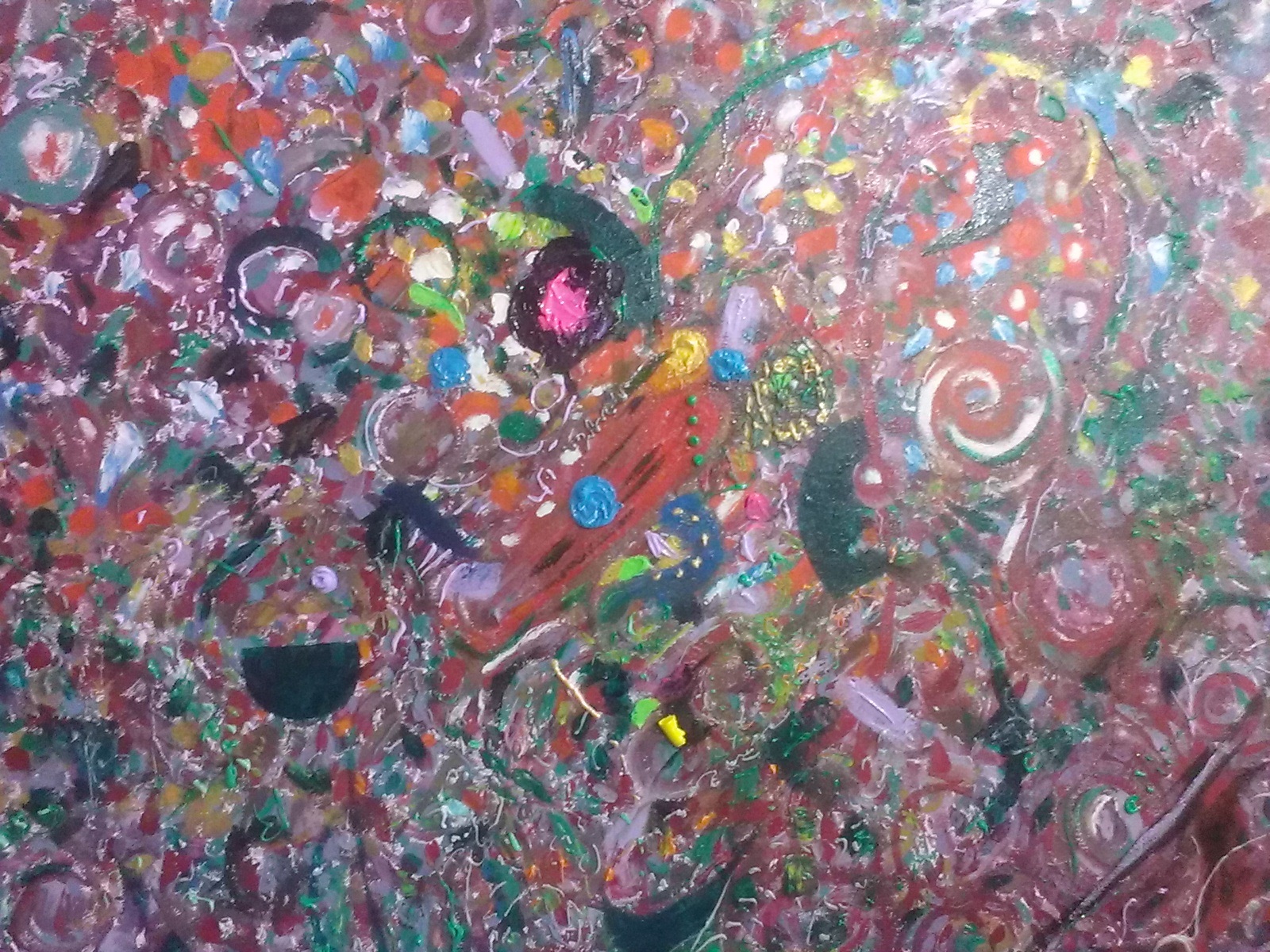
As I paint this piece, I see so many avenues within this idea open up, not just for myself as a painter but for others. One can approach it with a strict stroke of contrast, which could ultimately lead to a painting that reaches space or the core (theoretically) in a way similar, perhaps, to the wealth gained by the continued multiplication of pennies. One could also take an approach which exhausts every possibility of neutralization after each contrast and only then lays down the next contrast. This would not need to grow exponentially, but could nonetheless be painted forever.
It can also serve as a direction for people new to or intimidated by abstraction. If you are lost, or need a path or idea to help your compositional flow, then look to make contrasts that work with the overall piece . One can learn a lot about what harmonizes and what divides through experiments herein.
The idea is still to compose, to find harmony and not dissension. Contrast is not conflict. There is still a harmonic method to my composition that is not defied by contrast as it would be by conflict. Yet, by making sure I reiterate contrast, and look continually at the piece as a whole to find macro-cosmic contrast, a single stroke or mark that contrasts the whole piece as a working unit, I am lead to new ways of developing and shepherding the harmony the defines and evolves a painting. It is, among other things, another avenue towards compositional automatism. I am excited to see where this discovery can take the work…